A Level · Mathematics
A Level Maths revision guide (Cambridge 9709)
A Level Maths revision for Cambridge 9709: valid paper routes, topic checklists, how M, A and B marks work, 11 worked examples and 12-week and 6-week plans.
By ConceptCIE Team27 min read
Last updated
Good A Level Maths revision starts with knowing exactly what you will sit. This guide is for students taking Cambridge International AS & A Level Mathematics (syllabus code 9709), the Cambridge course taken in schools around the world. It covers which papers you need, how the marks are awarded, a topic checklist for every paper, eleven worked examples with full working, and plans for 12 weeks or 6 weeks.
The short answer
- AS Level is two papers sat in one series: Paper 1 plus Paper 2, 4 or 5.
- A Level is four papers: Papers 1, 3 and 5, plus either Paper 4 (Mechanics) or Paper 6 (Probability & Statistics 2). You cannot combine Papers 4 and 6.
- Papers 1 and 3 are 75 marks in 1 hour 50 minutes. Papers 2, 4, 5 and 6 are 50 marks in 1 hour 15 minutes. That is about 1.5 minutes per mark on every paper.
- A list of formulae and statistical tables (MF19) is supplied. Bring a scientific calculator, but show your working: unsupported calculator answers get no marks.
- Answers go to 3 significant figures (angles in degrees to 1 decimal place) unless the question says otherwise.
- Revise in three stages: learn the topics, then do topical questions, then do full timed papers. Keep an error log the whole way through.
9709 at a glance: papers, marks and timings
All six papers are written exams, marked by Cambridge. Every question is compulsory and you write your answers on the question paper.
| Paper | Content | Marks | Time | Questions | AS weight | A Level weight |
|---|---|---|---|---|---|---|
| 1 | Pure Mathematics 1 | 75 | 1 h 50 min | 10 to 12 | 60% | 30% |
| 2 | Pure Mathematics 2 | 50 | 1 h 15 min | 6 to 8 | 40% | not used |
| 3 | Pure Mathematics 3 | 75 | 1 h 50 min | 9 to 11 | not used | 30% |
| 4 | Mechanics | 50 | 1 h 15 min | 6 to 8 | 40% | 20% |
| 5 | Probability & Statistics 1 | 50 | 1 h 15 min | 6 to 8 | 40% | 20% |
| 6 | Probability & Statistics 2 | 50 | 1 h 15 min | 6 to 8 | not used | 20% |
The weights match the raw marks: an AS is out of 125 (75 + 50) and an A Level out of 250 (75 + 75 + 50 + 50). So every mark on Paper 1 counts the same as every mark on Paper 5. Do not treat the 50-mark papers as minor.
Cambridge expects about 180 guided learning hours for the AS and about 360 for the full A Level. Your own number will vary.
Which papers you need: valid routes
This is the part most students get wrong, so here is every route the 2026-2027 syllabus allows.
| Route | Papers | Series | Notes |
|---|---|---|---|
| AS, Pure only | 1 + 2 | Same series | AS only. Cannot be carried forward to A Level |
| AS, Pure + Mechanics | 1 + 4 | Same series | Can count towards a staged A Level |
| AS, Pure + Statistics | 1 + 5 | Same series | Can count towards a staged A Level |
| A Level, linear | 1 + 3 + 4 + 5 | Same series | Pure, Mechanics and Statistics |
| A Level, linear | 1 + 3 + 5 + 6 | Same series | Pure and Statistics only |
| A Level, staged | 1 + 4, then 3 + 5 | AS first, then a later series | AS result carried forward |
| A Level, staged | 1 + 5, then 3 + 4 | AS first, then a later series | AS result carried forward |
| A Level, staged | 1 + 5, then 3 + 6 | AS first, then a later series | AS result carried forward |
| Not allowed | 4 + 6 in any A Level | n/a | Paper 6 needs the Paper 5 content |
| Not allowed | 2 and 3 together | Same series | Paper 2 is AS only, Paper 3 is A Level only |
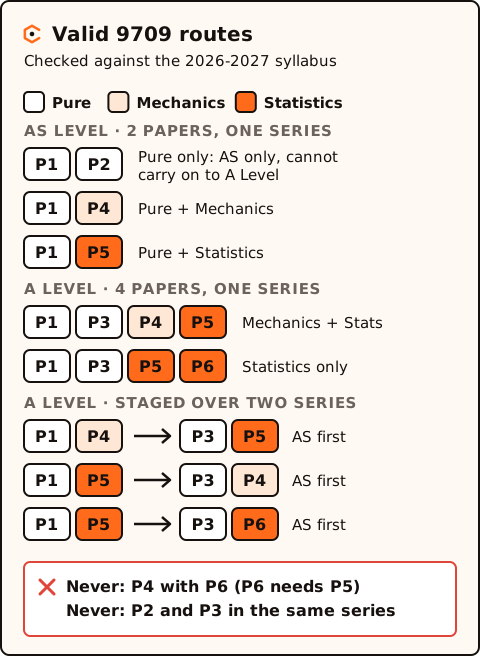
A few rules sit behind that table:
- Paper 5 is in every A Level route. If you are doing the full A Level, you are doing statistics.
- Paper 2 is a dead end for the A Level. Paper 2 content is largely a subset of Paper 3, but a Paper 1 and 2 AS cannot be carried forward. If you might continue, take Paper 1 with Paper 4 or 5 at AS.
- Carrying forward an AS result to finish a staged A Level is subject to rules and time limits in the Cambridge Handbook. Your exams officer has the details.
- A fallback AS grade. If you sit the full A Level and miss grade E, Cambridge can still award an AS grade, as long as your papers included a complete AS combination and you did well enough on those papers.
- Thinking of Further Mathematics (9231)? Cambridge recommends certain 9709 combinations to prepare for it and points teachers to the 9231 syllabus and its prior learning guide. Ask your teacher before you choose between Mechanics and Statistics.
Your school makes the entries, so confirm your route with your teacher or exams officer before you plan revision.
Exam series, calculators, MF19 and accuracy rules
Series. 9709 is examined in the June and November series. Schools in India can also enter in March. Cambridge groups schools into administrative zones, each with its own timetable, and writes different question papers for different zones. That is why you see codes such as 9709/11, 9709/12 and 9709/13: the first digit is the paper, the second marks a different version of it. Find your dates on the Cambridge exam timetables page. Private candidates can enter too.
Calculators. You need a scientific calculator. Computers, graphical calculators, and calculators that do symbolic algebra, differentiation or integration are not allowed. Cambridge's June 2024 examiner report adds a warning: solving an equation on your calculator and writing only the answer is not enough. Show the factorisation, the formula with numbers substituted, or the completed square. On Paper 3, the same report says cubic and quartic equations should be factorised, and complex number work needs full working too.
The formula list (MF19). Cambridge supplies the List of formulae and statistical tables (MF19) in the exam, and prints a copy in the syllabus. It is shared with Further Mathematics 9231, so skip the Further sections. For 9709 it gives you, among other things:
- mensuration, including arc length rθ and sector area ½r²θ (θ in radians)
- the quadratic formula, arithmetic and geometric series, and both binomial expansions
- trig identities, including compound and double angle formulae
- tables of standard derivatives and integrals, the product, quotient and parametric rules, and integration by parts
- the scalar product
- the four constant-acceleration (suvat) equations
- statistics formulae: mean and standard deviation, binomial, geometric and Poisson probabilities, E(X) and Var(X), unbiased estimators, the Central Limit Theorem
- normal distribution tables and critical values
When we checked the copy in the 2026-2027 syllabus, we could not find these, so learn them by heart: exact trig values for 30°, 45° and 60°, the equation of a circle, the discriminant, ½ab sin C, the trapezium rule (Paper 2), F = μR, momentum, work, kinetic and potential energy, power P = Fv, and the rules for E(aX + b) and Var(aX + bY). Check your own copy, because the list can be revised.
Accuracy. Give non-exact answers to 3 significant figures, and angles in degrees to 1 decimal place, unless the question asks for something else. To earn accuracy marks, do not round until the final answer. The June 2024 examiner reports suggest carrying at least 4 significant figures in the working.
Mechanics uses g = 10. The syllabus says Paper 4 expects the value 10 m s⁻² for g. Using 9.8 or 9.81 changes your answers.
Notation. Cambridge publishes a mathematics notation list for the symbols that may appear in the papers. Read it once.
Grades and thresholds
AS grades run from a to e. A Level grades run from A* to E. Grade thresholds are set after every series and differ between versions of the same paper. In November 2025, for example, the grade A threshold on Paper 3 was 45 out of 75 on one version and 60 out of 75 on another. There is no A* on a single paper: it is only awarded on the overall A Level. So never plan around "last year's grade boundaries". Aim to score as many marks as you can on whichever paper you get.
How 9709 marks are awarded: M, A, B and FT
Cambridge prints marking notes at the front of its 9709 mark schemes (we checked the June 2024 schemes). Knowing them changes how you should write answers.
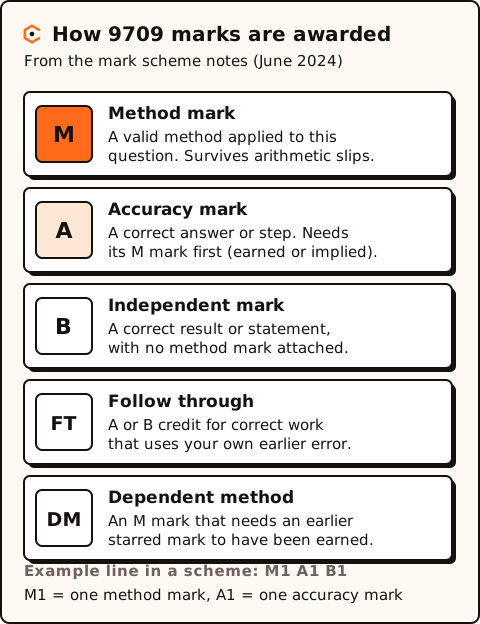
- M (method). For a valid method applied to this question. You keep it even after numerical slips, algebra slips or unit errors. Quoting a formula is usually not enough: you have to put the question's numbers into it.
- A (accuracy). For a correct answer or a correct step. You cannot get an A mark unless you earned (or the examiner can see you would have earned) the M mark it depends on.
- B. A mark for a correct result or statement, independent of any method mark.
- DM or DB. A method or B mark that depends on an earlier one, marked with an asterisk in the scheme.
- FT (follow through). Lets you earn A or B marks for correct work that uses your own earlier wrong answer. Without FT, A and B marks need correct work only.
The schemes also use these abbreviations. Meanings are paraphrased from the June 2024 mark scheme notes:
| Abbreviation | Meaning |
|---|---|
| AEF / OE | Any equivalent form of the answer is accepted |
| AG | The answer is printed on the paper, so your working is checked extra carefully |
| CAO | Correct answer only: no follow through allowed |
| CWO | Correct working only |
| ISW | Ignore subsequent working |
| SOI | Seen or implied |
| SC | Special case: a set mark for a particular wrong approach |
| WWW | Without wrong working |
| AWRT | Answer which rounds to |
Two more rules from the same notes are worth knowing. Marks once gained are not taken away by later wrong working. And if you misread a number and use it consistently, without making the question easier, you lose only one A or B mark for the misread.
Pacing: minutes per mark
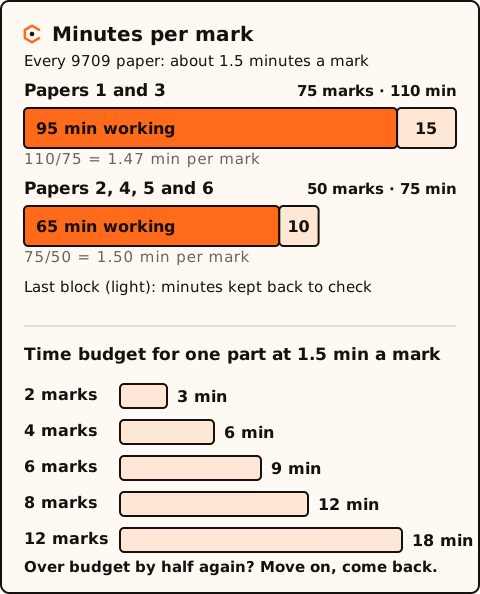
Paper 1 gives you 110 minutes for 75 marks (1.47 minutes a mark). The 50-mark papers give 75 minutes (1.5 minutes a mark). So a 4-mark part is worth about 6 minutes. If you are past 9 minutes on it, leave a gap, move on, and come back at the end.
Aim to finish your first pass with 10 to 15 minutes to spare. Arithmetic slips are the cheapest marks to win back, and you only catch them if you have time to look.
Paper-by-paper topic checklists
These lists follow the syllabus topic headings, in our own words. Tick a box only when you can do the skill on a past-paper question without notes. For the exact wording, read section 3 of the 9709 syllabus.
Paper 1: Pure Mathematics 1 (everyone)
- Quadratics: complete the square, use the discriminant (including repeated roots), solve quadratic inequalities, solve a linear and a quadratic equation together, and solve equations that are quadratic in x², √x or tan x
- Functions: domain, range, one-one, inverse and composite functions, and the graph of a function and its inverse reflected in y = x
- Transformations: y = f(x) + a, y = f(x + a), y = af(x), y = f(ax) and combinations, described as translations, reflections and stretches
- Coordinate geometry: equations of lines, parallel and perpendicular gradients, midpoints and distances; circles in the form (x − a)² + (y − b)² = r² and the expanded form; where lines meet curves and circles
- Circular measure: radians, arc length and sector area, combined with triangles
- Trigonometry: graphs of sin, cos and tan in degrees and radians, exact values, principal values of inverse functions, the identities tan θ = sin θ / cos θ and sin²θ + cos²θ = 1, and solving equations in a given interval
- Series: binomial expansion of (a + b)ⁿ for a positive integer n, arithmetic and geometric progressions, and the sum to infinity
- Differentiation: xⁿ for rational n, the chain rule, tangents and normals, increasing and decreasing functions, connected rates of change, stationary points and their nature
- Integration: integrate (ax + b)ⁿ, find the constant from a point, definite integrals (including simple improper ones), areas between curves and lines, volumes of revolution about an axis
Not tested on Paper 1: points of inflexion, general solutions of trig equations, implicit differentiation, and formal differentiation from first principles.
Paper 2: Pure Mathematics 2 (AS only)
- Modulus equations and inequalities, and the graph of y = |ax + b|
- Polynomial division, the factor theorem and the remainder theorem
- Laws of logarithms (no change of base), eˣ and ln x, solving equations with the unknown in a power, and turning y = kxⁿ or y = k(aˣ) into a straight line
- sec, cosec and cot, compound and double angle formulae, and R sin(θ ± α) or R cos(θ ± α) forms
- Derivatives of eˣ, ln x, sin x, cos x and tan x; product and quotient rules; parametric and implicit differentiation
- Integrating e^(ax+b), 1/(ax + b), sin, cos and sec² of (ax + b), using trig identities, and the trapezium rule (over- or under-estimate)
- Locating roots by a sign change and solving equations by iteration
Paper 3: Pure Mathematics 3 (A Level)
Paper 3 assumes Paper 1 and covers most Paper 2 topics (modulus, polynomials, logs, trig identities, calculus rules, iteration) at A Level depth. On top of that:
- Partial fractions with denominators up to (ax + b)(cx + d)(ex + f), (ax + b)(cx + d)² or (ax + b)(cx² + d)
- Binomial expansion of (1 + x)ⁿ for rational n, including the range of x for which it is valid
- The derivative of tan⁻¹ x, and integrating 1/(x² + a²)
- Integration using partial fractions, f′(x)/f(x), integration by parts and a given substitution
- Vectors in 2D and 3D: magnitude, unit vectors, the line r = a + tb, parallel, intersecting and skew lines, the scalar product and the angle between lines, the foot of a perpendicular
- First-order differential equations with separable variables, including forming them from a rate statement and interpreting the solution
- Complex numbers: Cartesian and polar forms, conjugate pairs of roots, Argand diagrams, square roots of a complex number, and loci
Not tested on Paper 3: change of base for logarithms, derivatives of sin⁻¹ x and cos⁻¹ x, the vector product, and the shortest distance between skew lines.
Paper 4: Mechanics
- Forces and equilibrium: force diagrams, components and resultants, resolving, smooth contact, friction with F = μR or F ≤ μR, limiting equilibrium, Newton's third law
- Kinematics in a straight line: displacement-time and velocity-time graphs, calculus with respect to time (Paper 1 techniques), and the constant-acceleration equations
- Momentum: conservation in a direct collision, including bodies that stick together
- Newton's laws: F = ma with friction, tension and thrust, W = mg with g = 10, vertical motion, inclined planes, and connected particles over pulleys or with tow-bars
- Energy, work and power: work done by a force at an angle, kinetic and potential energy, the work-energy principle, power P = Fv, and a car's acceleration on a hill
Not tested on Paper 4: impulse, the coefficient of restitution, and vector notation.
Paper 5: Probability & Statistics 1
- Representing data: stem-and-leaf (including back-to-back), box-and-whisker plots, histograms and cumulative frequency graphs
- Mean and standard deviation, including grouped data and totals such as Σx, Σx² or coded totals, for up to two data sets
- Permutations and combinations with repeated letters and restrictions (no circular arrangements)
- Probability: listing outcomes, combinations, exclusive and independent events, conditional probability and tree diagrams
- Discrete random variables: probability tables, E(X) and Var(X), and the binomial and geometric distributions
- The normal distribution: standardising with full working, finding μ or σ from a given probability, and the normal approximation to the binomial with a continuity correction (when np > 5 and nq > 5)
Paper 6: Probability & Statistics 2
Paper 6 assumes Paper 5 and the calculus from Paper 3.
- The Poisson distribution, including mean = variance, the Poisson approximation to the binomial, and the normal approximation to the Poisson
- Linear combinations: E(aX + b), Var(aX + b), and sums of independent normal or Poisson variables
- Continuous random variables: probability density functions, probabilities, mean, variance, median and percentiles
- Sampling: random samples, the distribution of the sample mean, the Central Limit Theorem, unbiased estimates, and confidence intervals for a mean or a proportion
- Hypothesis tests: one-tailed and two-tailed tests for binomial and Poisson observations, tests for a population mean, and Type I and Type II errors
Worked examples with full working
All eleven questions below are ConceptCIE originals, written for this guide. They are not past-paper questions. Every answer was checked numerically. Try each one before reading the working.
Example 1, Paper 1: stationary points
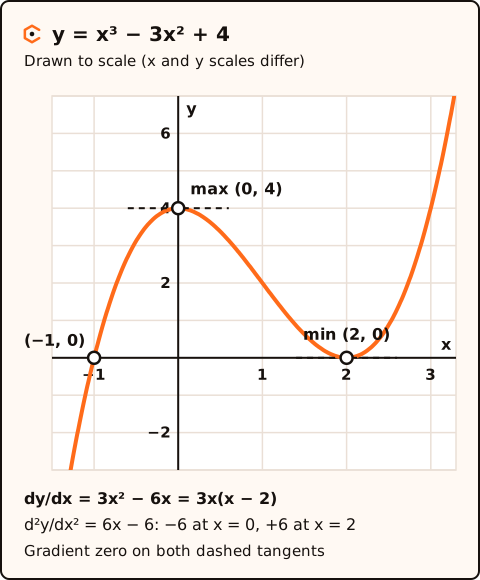
How method marks protect you here. Suppose you slip and write y = 2 at x = 2. You lose the accuracy mark for that coordinate, but your differentiation, your factorising and your second-derivative test are all still valid methods. The nature of the point does not depend on the wrong y-value, so that part can still score. That is the M and FT system at work, and it only helps you if every step is written down. (This is our illustration of the general rules above, not an official scheme for this question.)
Example 2, Paper 1: a trig equation
Check by substituting: at 60°, 2 × (√3/2)² = 1.5 and 3 × ½ = 1.5. Write the factorised line: the examiner report warns that a quadratic solved only on a calculator may not earn the marks.
Example 3, Paper 1: a binomial coefficient
The usual slip is losing the minus sign inside (−x)². Put brackets round the whole term every time.
Example 4, Paper 1: radians, arcs and segments
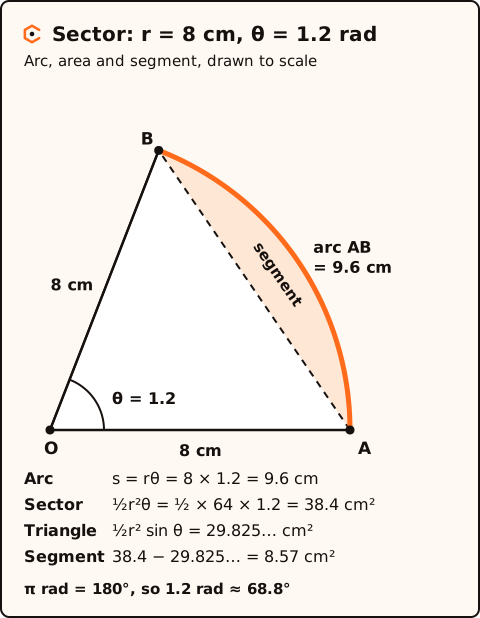
Example 5, Paper 1: chain rule and rates of change
Example 6, Paper 1: area between a curve and a line
Example 7, Paper 3: product rule
The syllabus allows any valid test for the nature of a stationary point when the question does not name a method, so checking the sign of the gradient is fine here.
Example 8, Paper 3: binomial expansion with a rational power
On a similar expansion, Cambridge's June 2024 examiner report named a major source of error: using x instead of the whole term (here 3x) when substituting.
Example 9, Paper 4: velocity-time graph and constant acceleration
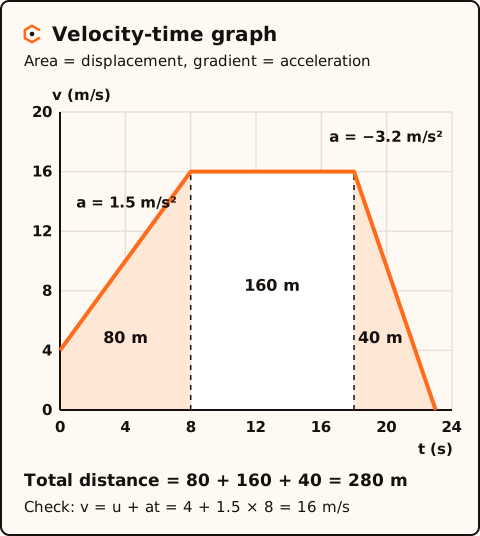
A quick extra on vertical motion with g = 10: a stone thrown straight up at 14 m/s rises until v = 0, so 0 = 14² − 2 × 10 × s, giving s = 9.8 m, and it returns to the same level after 2 × 14 ÷ 10 = 2.8 s. If a question gives velocity as a function of time, use calculus instead: the suvat equations only work when acceleration is constant.
Example 10, Paper 5: normal distribution
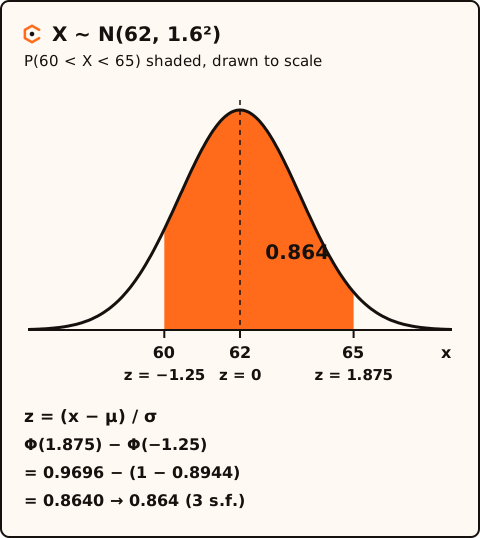
The syllabus asks for full working whenever you standardise, so write the z = (x − μ) ÷ σ line with numbers in it.
Example 11, Paper 6: a hypothesis test
Cambridge's June 2024 examiner report on Paper 6 says conclusions must be in context and use language that shows uncertainty. "There is not enough evidence that…" does both. "The rate has not changed" does neither.
Common errors, paper by paper
What Cambridge examiners reported (June 2024)
These points paraphrase the key messages in Cambridge's June 2024 principal examiner report for 9709. One series only, so read the latest report too.
- Paper 1: answers to quadratic and trig equations taken straight from a calculator, with no factorising, formula or completed square shown. Quoting a formula without substituting into it.
- Paper 3: answers that did not match what the question asked; missing brackets that broke otherwise good work; overwritten work that is hard to read when scanned; complex numbers and vectors often left blank; unfactorised cubics and quartics; big jumps in working on integration.
- Paper 4: no force diagram, so a force was missed when resolving or using F = ma; rounding too early; using suvat when velocity was a function of time.
- Paper 5: unclear communication, especially when proving a given result; exact answers that should have been left exact (fractions do not need converting to decimals); intermediate values rounded below 4 significant figures.
- Paper 6: hypothesis-test conclusions that were not in context or sounded certain; textbook statements instead of answers about the situation in the question; unclear digits.
General advice (ConceptCIE, not from Cambridge)
- Functions: forgetting to state the domain of an inverse, or composing in the wrong order (fg(x) means do g first).
- Coordinate geometry: using the gradient of the line instead of the perpendicular gradient for a normal.
- Integration: missing the + c on indefinite integrals, or forgetting to subtract the lower limit when it is not zero.
- Vectors: finding a direction vector the wrong way round, then getting the sign wrong in the scalar product.
- Mechanics: weight resolved with sin and cos swapped on an inclined plane. Draw the right angle on your diagram.
- Statistics: no continuity correction in a normal approximation; mixing up "at least" and "more than" with discrete variables.
The error log: your most useful revision tool
An error log is a table of every mark you lose in practice, with a rule to stop it happening again. After a few weeks, patterns show up. Most students find the same three or four habits behind most of their lost marks.
| Date | Question | Topic | Marks lost | Type | What went wrong | Rule for next time | Retest on |
|---|---|---|---|---|---|---|---|
| 2 Mar | Own practice Q4 | Circular measure | 3 | Slip | sin 1.2 in degree mode | Radians question: set RAD before starting | 9 Mar |
| 4 Mar | Topical set, Q7 | Stationary points | 2 | Gap | Found x but no y or nature | After dy/dx = 0: find y, then test the nature | 11 Mar |
| 6 Mar | Timed paper, Q9 | Normal distribution | 1 | Rounding | Rounded z to 1 d.p. | Keep 4 s.f., round once at the end | 13 Mar |
The rows are examples of the format, not real past-paper references. Use your own question numbers.
- Mark every practice question the same day with the official mark scheme.
- Log every lost mark, even single ones. Pick one type: slip, gap in knowledge, misread, method choice or time.
- Write the rule as an instruction you can follow in the exam, not as "be careful".
- Retest the topic a week later with a fresh question. Strike out the row only when you get it right.
- Every Sunday, count the types. Spend the next week's spare time on the biggest one.
How to use past papers properly
Cambridge publishes a selection of 9709 past papers, mark schemes, examiner reports and the 2020 specimen papers on its 9709 past papers page. Registered schools can get more through Cambridge's School Support Hub, so ask your teacher for recent papers.
- Topical before timed. Early on, do past questions grouped by topic, untimed, until the method feels automatic. Full timed papers too early mostly teach you what running out of time feels like.
- Save some full papers. Keep at least four or five complete, unseen sets for weeks 9 to 11.
- Sit them properly. Real time limit, MF19 only, your exam calculator, no phone.
- Do not memorise answers. Recent papers repeat ideas, not questions. If you recognise a question, use it for speed practice, not as a score.
- Read the examiner report for each paper you sit. It explains where marks were lost across many candidates.
How to review a mark scheme
- Read the question again, then find its row in the scheme.
- For each mark, ask what earned it: a method (M), a result (A), a stand-alone fact (B).
- Compare your line with the scheme line by line. Did you show every step that carries an M mark?
- Check the Guidance column for accepted alternatives, rounding (AWRT) and CAO notes.
- Where you lost a mark, log it with a rule.
- Rewrite the full solution once, cleanly, as if you were the examiner's model answer.
How to plan your A Level Maths revision
A 12-week plan
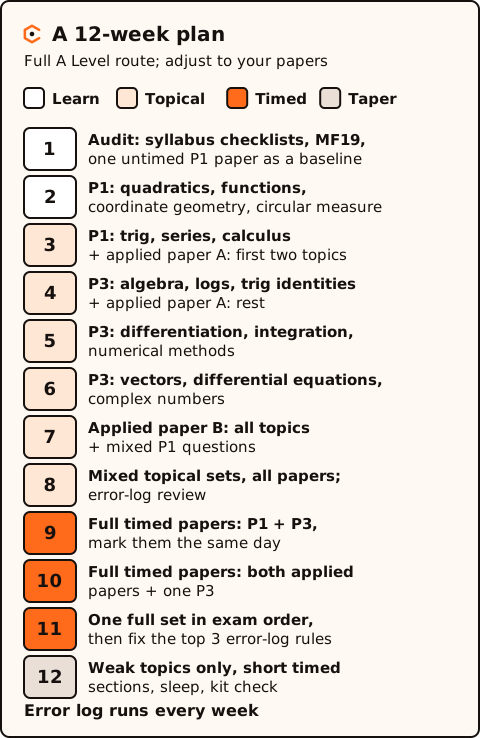
Applied paper A and B here mean your two applied papers: Mechanics and Statistics 1, or Statistics 1 and 2. If Paper 5 is one of them, start with it, because Paper 6 builds on it.
A 6-week crash plan
| Week | Focus | By the end of the week |
|---|---|---|
| 1 | Audit and Paper 1 core | One untimed Paper 1, checklists ticked or flagged, error log started |
| 2 | Paper 3 algebra and calculus (Paper 2 for AS) | Topical sets on partial fractions, logs, trig identities, integration |
| 3 | Paper 3 vectors, complex numbers, differential equations, plus applied paper A | One topical set per day |
| 4 | Applied paper B and mixed topical questions | Every flagged checklist item attempted |
| 5 | Full timed papers | Two or three complete sets, marked the same day |
| 6 | Weak topics and one final set in exam order | Top three error-log rules written on one card |
A weekly timetable
An example for a school week. Shift it around your lessons, but keep the pattern: short daily sessions, one longer timed block, and a weekly review.
| Day | Session 1 (45 to 60 min) | Session 2 (30 min) |
|---|---|---|
| Monday | Pure topic of the week: topical questions | Retest two error-log rows |
| Tuesday | Applied paper A: topical questions | MF19 drill: find and use five formulae |
| Wednesday | Mixed Pure questions | Flashcards for facts not on MF19 |
| Thursday | Applied paper B: topical questions | Retest two error-log rows |
| Friday | Rest, or a light review | None |
| Saturday | Timed block: half a paper (weeks 1 to 8) or a full paper (weeks 9 to 11) | Mark it with the scheme the same day |
| Sunday | Count error types and plan next week | None |
Exam day
- Bring a scientific calculator you have practised with, a ruler and pens. Check the angle mode (degrees or radians) at the start of every trig question. The syllabus says a protractor and compasses are not required.
- Read the front cover: it states the accuracy rule and, on Paper 4, g = 10.
- Do a fast first pass. Answer what you can, and leave a clear gap for anything over budget.
- Keep 10 to 15 minutes for a second pass and checks: substitute answers back, check the calculator mode, check you answered every part.
- If you run out of space, use the extra page at the end and write the question number clearly.
Command words in 9709
The 9709 syllabus lists eleven command words. Here is what each one asks you to do in a maths answer, in our words. The official definitions are on page 42 of the 2026-2027 syllabus.
| Command word | What to do in a 9709 answer |
|---|---|
| Calculate | Work out a value from the information given, showing the steps |
| Describe | Give the main features, for example name a transformation and give its details |
| Determine | Find a result with certainty, with working that justifies it |
| Evaluate | Work out the value of something (or, less often, judge it) |
| Explain | Give reasons or say how something works, linked to the question |
| Identify | Name or pick out the right thing |
| Justify | Back up a statement or choice with working or an argument |
| Show (that) | Build a clear chain of steps that ends at the result printed in the question |
| Sketch | Freehand drawing with the key features (intercepts, turning points, asymptotes) in sensible proportion |
| State | Write the answer clearly; long working is not expected |
| Verify | Confirm that a given result is true, for example by substituting |
You will also meet instructions such as find, solve, hence and hence or otherwise. They are not in the syllabus list. In practice, "hence" means use the previous result, and "hence or otherwise" means the previous result is the expected route, but another correct method also earns the marks.
Get help with 9709
Our AI Mathematics tutor, Mr Axis, is being updated. You can see his page now, and a free ConceptCIE account is the way to hear when he is ready.
More from the ConceptCIE blog:
Last checked: 16 October 2026, against the Cambridge 9709 syllabus for 2026 and 2027 (version 4), the June 2024 mark schemes and examiner report, and the November 2025 grade threshold table.
Quick answers
Which papers do I need for Cambridge A Level Maths 9709?
Four papers: Paper 1 (Pure Mathematics 1), Paper 3 (Pure Mathematics 3), Paper 5 (Probability & Statistics 1), and either Paper 4 (Mechanics) or Paper 6 (Probability & Statistics 2). AS Level is two papers: Paper 1 plus Paper 2, 4 or 5. Your school makes the entry, so check with your exams officer which route you are on.
Can I take Paper 4 and Paper 6 together?
No. The syllabus does not allow Paper 4 (Mechanics) with Paper 6 (Probability & Statistics 2), because Paper 6 assumes the content of Paper 5. Every A Level route includes Paper 5.
Can I take AS with Papers 1 and 2 and then finish the A Level?
No. The Pure Mathematics only AS route (Papers 1 and 2) is AS only, and that result cannot be carried forward to complete the A Level. If you might want the full A Level, take Paper 1 with Paper 4 or Paper 5 at AS.
Is there a formula sheet in 9709 exams?
Yes. Cambridge supplies the List of formulae and statistical tables (MF19) in the exam. It is shared with Further Mathematics 9231, so ignore the sections headed Further Pure Mathematics, Further Mechanics and Further Probability & Statistics. A copy is printed in the syllabus, so practise with it from the start.
What calculator can I use for 9709?
A scientific calculator. The syllabus does not allow computers, graphical calculators, or calculators that do symbolic algebra, differentiation or integration. You must still show your working: no marks are given for unsupported answers from a calculator.
How accurate should my answers be?
Unless a question says otherwise, give non-exact answers to 3 significant figures and angles in degrees to 1 decimal place. Keep more figures during the working (examiner reports suggest at least 4 significant figures) and round only at the end.
How long should I spend on each mark?
Every 9709 paper works out at about 1.5 minutes per mark: 110 minutes for 75 marks on Papers 1 and 3, and 75 minutes for 50 marks on Papers 2, 4, 5 and 6. Work a little faster than that so you have time to check.
Is this guide useful for Edexcel, AQA or OCR A Level Maths?
The techniques, worked examples, error log and plans transfer to any board, but the paper structure, routes, formula booklet and mark rules here are for Cambridge International 9709 only. UK boards have different papers and content, so check your own specification.
Sources
- Cambridge International AS & A Level Mathematics 9709 syllabus for 2026 and 2027 (version 4)www.cambridgeinternational.org
- Syllabus update for 9709, 2026 and 2027 (December 2025)www.cambridgeinternational.org
- Cambridge International AS & A Level Mathematics 9709 syllabus for 2028, 2029 and 2030 (version 1)www.cambridgeinternational.org
- Cambridge International AS & A Level Mathematics 9709: subject pagewww.cambridgeinternational.org
- 9709 past papers, mark schemes, examiner reports and specimen papers (Cambridge)www.cambridgeinternational.org
- 9709 mark scheme, Paper 11, June 2024 (mark types and abbreviations)www.cambridgeinternational.org
- 9709 principal examiner report for teachers, June 2024www.cambridgeinternational.org
- 9709 grade threshold table, November 2025www.cambridgeinternational.org
- Mathematics notation list (Cambridge)www.cambridgeinternational.org
- Cambridge International exam timetableswww.cambridgeinternational.org
Revise with ConceptCIE
Subject tutors, notes and harder-than-exam practice for Cambridge International students. Parts are still being updated; a free account gets each one as it opens.
No card · 10 free tutor prompts when tutor chat opens
Related posts
Cambridge IGCSE Physics (0625): revision guide
24 min read
Cambridge IGCSE Physics 0625 revision: how the papers work, topic checklists, key equations, worked examples, practical skills, and 8-week and 4-week plans.