IGCSE · Physics
Cambridge IGCSE Physics (0625): revision guide
Cambridge IGCSE Physics 0625 revision: how the papers work, topic checklists, key equations, worked examples, practical skills, and 8-week and 4-week plans.
By ConceptCIE Team24 min read
Last updated
This is a revision guide for Cambridge IGCSE Physics 0625, for Core and Extended students. It explains how the exam is built, gives you a checklist for every topic, lists the equations you must learn, and works through eight calculations in the layout examiners reward. It ends with the practical papers, two revision plans and the mistakes Cambridge's own examiners keep reporting.
Cambridge IGCSE Physics 0625 at a glance
- Every candidate takes three papers: a multiple-choice paper (30%), a theory paper (50%) and one practical paper (20%).
- Core route: Papers 1, 3 and 5 or 6, grades C to G. Extended route: Papers 2, 4 and 5 or 6, grades A* to G.
- The syllabus has six topics split into 24 sections. Every topic has Core content and extra Supplement content for Extended.
- Calculators are allowed in every paper. Equations are "recall and use", so learn them.
- Exams run in the June and November series, plus March in India.
How the 0625 exam is built
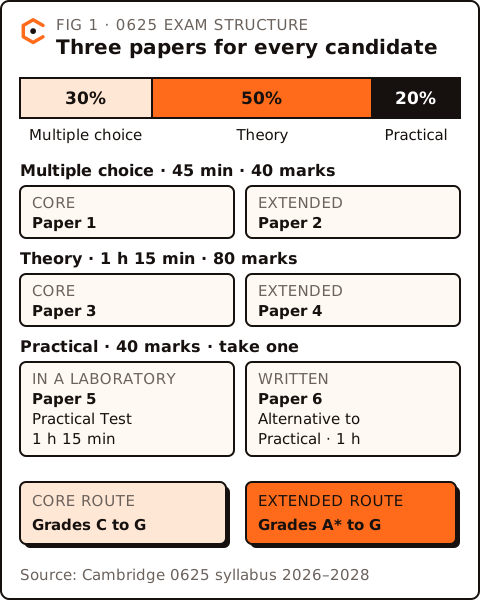
| Paper | Route | Time | Marks | Weighting | Time per mark |
|---|---|---|---|---|---|
| 1 Multiple Choice | Core | 45 min | 40 | 30% | about 67 s a question |
| 2 Multiple Choice | Extended | 45 min | 40 | 30% | about 67 s a question |
| 3 Theory | Core | 1 h 15 min | 80 | 50% | about 56 s a mark |
| 4 Theory | Extended | 1 h 15 min | 80 | 50% | about 56 s a mark |
| 5 Practical Test | Both | 1 h 15 min | 40 | 20% | includes doing the experiments |
| 6 Alternative to Practical | Both | 1 h | 40 | 20% | about 90 s a mark |
Each multiple-choice paper has 40 questions with four options. The theory papers use short-answer and structured questions, and you write your answers on the question paper. There is no coursework.
Core or Extended: what actually changes
The Extended syllabus is the Core content plus the Supplement. Cambridge says students taught only the Core can reach a maximum of grade C, and that Extended is meant for students expected to get C or above. In practice the Supplement adds:
- more equations (acceleration, momentum, kinetic energy, specific heat capacity, refractive index and others in the table below)
- harder skills, such as trigonometry, gradients of curves using a tangent, and the prefixes giga, micro and nano (Core students use mega, kilo, centi and milli)
- deeper explanations, for example why gases expand more than solids, or how a split-ring commutator works
The practical paper is the same choice for both routes, and Cambridge says its questions cover the full grade range.
What the marks are testing
Cambridge weights three assessment objectives: knowledge with understanding (50%), handling information and problem-solving (30%) and experimental skills (20%). The written papers 1 to 4 are about 63% knowledge and 37% problem-solving. Papers 5 and 6 test experimental skills only.
The six topics
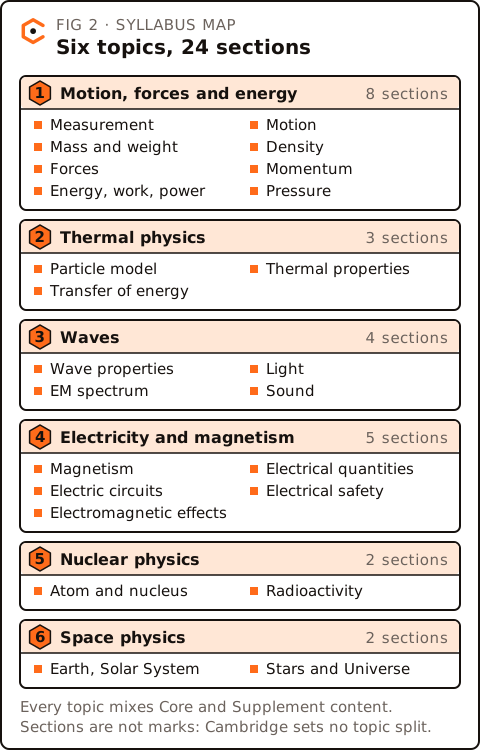
Use the checklists below to find gaps. Tick an item only when you can explain it without notes and answer a question on it. Items marked (Extended) are Supplement content: Core students can skip them.
1 Motion, forces and energy
- Measure lengths, volumes and short times; time many swings of a pendulum and divide to get one
- Scalars and vectors; the resultant of two vectors at right angles, by drawing or calculation (Extended)
- Speed, average speed and velocity
- Distance–time and speed–time graphs: the shapes for at rest, steady speed, speeding up and slowing down
- Speed from the gradient of a distance–time graph; distance from the area under a speed–time graph
- Acceleration from a speed–time gradient, deceleration as negative acceleration, terminal velocity (Extended)
- Mass and weight, W = mg, and g of about 9.8 m/s² near the Earth's surface
- Density, including the displacement method for irregular solids, and predicting floating
- Load–extension graphs and the experiment behind them
- Spring constant k = F ÷ x and the limit of proportionality (Extended)
- Resultant force along a line, friction and drag; F = ma and circular motion (Extended)
- Moments, the principle of moments, centre of gravity and stability; several forces each side of a pivot (Extended)
- Momentum, impulse and conservation of momentum (Extended)
- Energy stores and transfers, conservation of energy, energy resources
- Kinetic and gravitational potential energy, Sankey diagrams, efficiency equations (Extended)
- Work done and power
- Pressure = force ÷ area, and how liquid pressure changes with depth; Δp = ρgΔh (Extended)
2 Thermal physics
- Properties and particle diagrams of solids, liquids and gases
- Temperature and particle motion, absolute zero, converting between °C and K
- Gas pressure from particle collisions; effect of temperature and volume on pressure
- pV = constant at constant temperature, with its graph (Extended)
- Brownian motion as evidence for moving particles
- Thermal expansion and its uses; why gases expand most (Extended)
- Internal energy rises with temperature
- Specific heat capacity: the equation and the experiment (Extended)
- Melting, boiling, evaporation, condensation and solidification; the melting and boiling points of water
- Boiling versus evaporation, and what speeds up evaporation (Extended)
- Conduction, convection and radiation; experiments on conductors and on convection; how surface colour and texture affect radiation
- Conduction by lattice vibrations and free electrons; experiments on emitters and absorbers; energy balance and the Earth's temperature (Extended)
3 Waves
- Waves transfer energy, not matter; wavelength, frequency, amplitude, wavefront, wave speed
- v = fλ
- Transverse and longitudinal waves, with examples
- Reflection, refraction and diffraction, including the ripple tank; how gap size and wavelength affect diffraction (Extended)
- Plane mirror images; angle of incidence equals angle of reflection
- Refraction through blocks, critical angle, total internal reflection
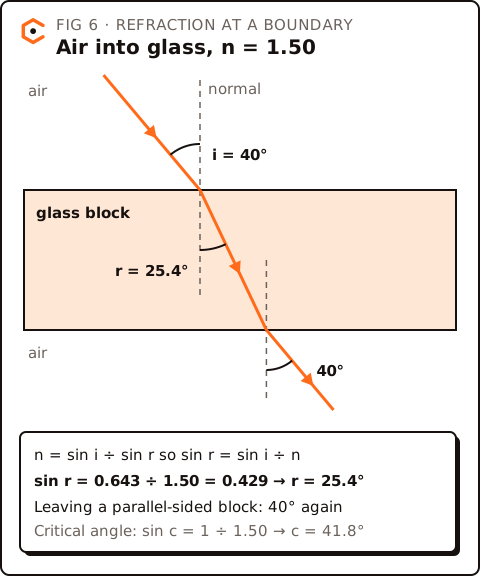
- Refractive index, n = sin i ÷ sin r, n = 1 ÷ sin c, optical fibres (Extended)
- Converging and diverging lenses, ray diagrams for real images
- Ray diagrams for virtual images, the magnifying glass, correcting long and short sight (Extended)
- Dispersion by a prism and the order of the seven colours
- The electromagnetic spectrum: order, uses, hazards, same speed in a vacuum
- The speed 3.0 × 10⁸ m/s, communication choices, digital versus analogue signals (Extended)
- Sound: longitudinal, needs a medium, 20 Hz to 20 000 Hz, about 330–350 m/s in air, echoes, ultrasound
- Compressions and rarefactions, sound in solids and liquids, uses of ultrasound (Extended)
4 Electricity and magnetism
- Magnets, induced magnetism, soft iron and steel, field lines and how to plot them
- Charge, charging by friction, conductors and insulators; electric fields (Extended)
- Current, ammeters, d.c. and a.c.; I = Q ÷ t and conventional current (Extended)
- e.m.f. and p.d., voltmeters; E = W ÷ Q and V = W ÷ Q (Extended)
- R = V ÷ I and measuring resistance; resistance, length and thickness of a wire
- Current–voltage graphs for a resistor, a filament lamp and a diode (Extended)
- P = IV, E = IVt, kilowatt-hours and the cost of electricity
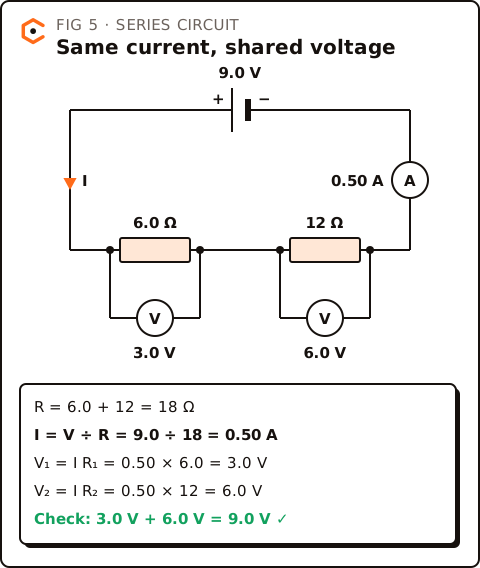
- Circuit symbols, series and parallel rules, combined resistance in series
- Combined resistance of two resistors in parallel, the junction rule, potential dividers, diodes and LEDs (Extended)
- Mains safety: live, neutral and earth, fuses, trip switches, earthing and double insulation
- Electromagnetic induction; the a.c. generator and the direction of induced e.m.f. (Extended)
- Magnetic fields of wires and solenoids, relays and loudspeakers
- Force on a wire in a magnetic field and the d.c. motor; direction rules and the commutator (Extended)
- Transformers and high-voltage transmission; IpVp = IsVs and P = I²R (Extended)
5 Nuclear physics
- Atoms, ions, protons, neutrons, proton number, nucleon number, nuclide notation, isotopes
- Alpha-scattering evidence, fission and fusion (Extended)
- Background radiation and its sources; count rate
- Alpha, beta and gamma: what they are, how they ionise and how far they penetrate
- Corrected count rate, deflection in fields, decay equations (Extended)
- Decay is random and spontaneous; alpha and beta decay change the element
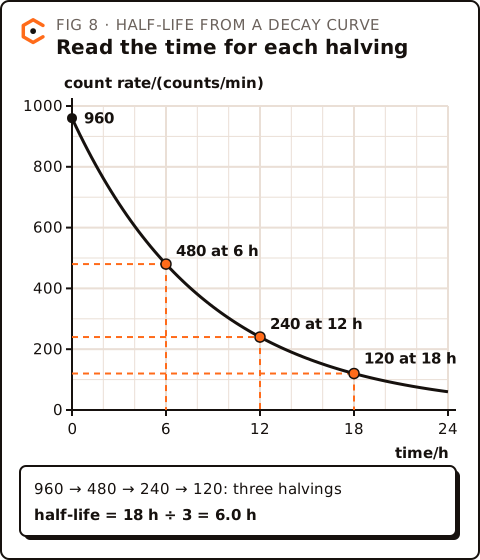
- Half-life from tables and decay curves
- Half-life when background has not been subtracted; choosing isotopes for uses (Extended)
- Effects of radiation on living things; moving, using and storing sources safely
- Explaining safety precautions in terms of time, distance and shielding (Extended)
6 Space physics
- Day and night, seasons, phases of the Moon
- The Solar System, the order of the planets and the accretion model
- Gravity: field strength and distance; why planets orbit the Sun; light travel times
- Orbital speed v = 2πr ÷ T, elliptical orbits, planetary data (Extended)
- The Sun as a star, galaxies, light-years, redshift and the expanding Universe
- Life cycle of stars, CMBR, the Hubble constant and the age of the Universe (Extended)
Key equations to learn
The syllabus lists each of these as "recall and use". The tables give the usual units from the syllabus and the rearrangements you will need.
Core and Extended
| Quantity | Equation | Units | Rearranged |
|---|---|---|---|
| Speed | v = s ÷ t | m/s | s = vt, t = s ÷ v |
| Weight | W = mg (g = W ÷ m) | N, kg, N/kg | m = W ÷ g |
| Density | ρ = m ÷ V | kg/m³ or g/cm³ | m = ρV, V = m ÷ ρ |
| Moment | moment = F × d | N m | d = moment ÷ F |
| Work done | W = Fd = ΔE | J | F = W ÷ d |
| Power | P = W ÷ t = ΔE ÷ t | W | W = Pt |
| Pressure | p = F ÷ A | Pa (N/m²) | F = pA |
| Temperature | T (K) = θ (°C) + 273 | K, °C | θ = T − 273 |
| Wave speed | v = fλ | m/s, Hz, m | f = v ÷ λ |
| Resistance | R = V ÷ I | Ω | V = IR |
| Electrical power | P = IV | W | I = P ÷ V |
| Electrical energy | E = IVt | J or kWh | t = E ÷ (IV) |
| Series resistors | R = R₁ + R₂ + … | Ω | |
| Transformer | Vp ÷ Vs = Np ÷ Ns | V | Vs = Vp × Ns ÷ Np |
Extended only
| Quantity | Equation | Units |
|---|---|---|
| Acceleration | a = Δv ÷ Δt | m/s² |
| Spring constant | k = F ÷ x | N/m or N/cm |
| Force | F = ma | N |
| Momentum and impulse | p = mv; impulse = FΔt = Δ(mv); F = Δp ÷ Δt | kg m/s, N s |
| Kinetic energy | Ek = ½mv² | J |
| Change in GPE | ΔEp = mgΔh | J |
| Efficiency | useful output ÷ total input (× 100%) | none, or % |
| Liquid pressure | Δp = ρgΔh | Pa |
| Gas at constant temperature | pV = constant | |
| Specific heat capacity | c = ΔE ÷ (mΔθ) | J/(kg °C) |
| Refractive index | n = sin i ÷ sin r; n = 1 ÷ sin c | none |
| Charge, e.m.f., p.d. | I = Q ÷ t; E = W ÷ Q; V = W ÷ Q | C, V |
| Potential divider | R₁ ÷ R₂ = V₁ ÷ V₂ | |
| Transformer power | IpVp = IsVs; cable losses P = I²R | W |
| Orbital speed | v = 2πr ÷ T | m/s |
| Hubble constant | H₀ = v ÷ d; age of Universe ≈ 1 ÷ H₀ | per second |
Parallel resistors (Extended): the syllabus asks you to calculate the combined resistance of two resistors in parallel. Use 1 ÷ R = 1 ÷ R₁ + 1 ÷ R₂, or the shortcut R = (R₁ × R₂) ÷ (R₁ + R₂) for exactly two.
The calculation method
Cambridge's June 2024 examiner report repeatedly asks candidates to write the equation first, show working, use the syllabus symbols, give a unit and round sensibly. That fits a five-step layout:
- Write the equation in symbols or words. Use the syllabus symbols: t for time, T or θ for temperature, E for energy, Q for charge.
- Convert units before you substitute: kHz to Hz, cm to m, minutes to seconds, g to kg.
- Substitute with the numbers visible.
- Calculate, then give the answer with its unit, rounded to the same number of significant figures as the data (usually 2 or 3, rarely 1).
- Sense-check the size and direction of your answer.
Worked examples
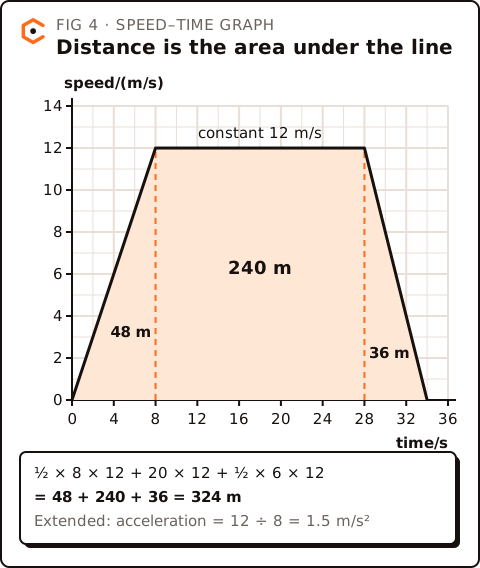
These follow the five steps. Try each question yourself first, then compare.
Command words: what each one wants
The 0625 syllabus defines 15 command words. Read the official definitions in your syllabus. The table below puts them in our own words.
| Command word | What to do | Typical length |
|---|---|---|
| State, Give | Say the fact or value, no reason needed | A word to a sentence |
| Identify | Pick out or name the thing asked for | A word or phrase |
| Define | Give the exact meaning of a term | One precise sentence |
| Describe | Say what happens or what something is like | A few linked points |
| Explain | Say why or how, linking cause and effect | A chain of reasons |
| Compare | Give similarities or differences, side by side | Paired points |
| Calculate | Work out a number from the data, with working | Equation, working, answer, unit |
| Determine | Get an answer from the information given, often a graph | Working plus answer |
| Deduce | Draw a conclusion from the information given | A short reasoned answer |
| Predict | Say what will happen, based on the information | A short answer |
| Suggest | Apply ideas to a new situation where several answers could work | One or two sensible ideas |
| Justify | Back up a choice or claim with evidence | Claim plus evidence |
| Comment | Give an informed opinion on what is shown | A judgement with a reason |
| Sketch | Draw freehand, showing key features and sensible proportions | A labelled sketch |
Here is the same idea answered badly and well, for ConceptCIE questions:
| Question | Weak answer | Stronger answer |
|---|---|---|
| Define density. | How heavy something is for its size. | Mass per unit volume. |
| Describe the tram's motion in Example 1. | It goes fast then slows down. | Speed increases steadily to 12 m/s in 8 s, stays at 12 m/s for 20 s, then decreases steadily to zero at 34 s. |
| Explain why the ray in Example 6 bends towards the normal. | Because of refraction. | Light travels more slowly in glass than in air, so the ray changes direction towards the normal as it enters the glass. |
| Suggest why the value of c in Example 4 is higher than the accepted value. | Human error. | Some energy from the heater warmed the air instead of the block, so the temperature rise was smaller than expected and the calculated c was too big. |
Paper 3 and Paper 4 technique
- Pace by marks. You have about 56 seconds a mark, so a 4-mark part is worth about 4 minutes. If a part runs well over, move on and come back.
- Count the points. The June 2024 examiner report advises looking at both the marks and the space given: a 2-mark question needs two separate points. The answer space is a guide to length, not a target to fill.
- Name the thing. Examiners reported answers that used "it" and "they" without saying what they meant, and answers that said a quantity "changed" without saying whether it increased or decreased. Write "the pressure of the gas increases", not "it changes".
- Apply, don't recite. Several 2024 questions were like a familiar experiment but not the same. Use the details in the question and the diagram.
- Write numbers clearly. The report mentions 1s that look like 7s and 0s that look like 6s. If you change an answer, cross the old one out and write the new one clearly.
- Multiple choice: for numerical questions, work the answer out on the paper before looking at the options, as the examiners recommend.
The practical papers: Paper 5 and Paper 6
Paper 5 is a Practical Test: you carry out experiments in a laboratory. Paper 6, the Alternative to Practical, is a written paper about experiments, and you do not carry any out. Cambridge says both need the same skills, cover the same experimental contexts and test the same assessment objective. Your school decides which one you sit.
The syllabus groups the skills into five areas. Turn each one into practice:
- Use apparatus safely and well: recognise equipment from diagrams, choose the right instrument and say why, spot hazards.
- Plan: name the independent and dependent variables, say which variables you will control and how, choose a sensible number and range of values.
- Measure and record: read scales to the nearest half division, correct zero errors, repeat readings, record in a table with units in the column headings.
- Interpret and evaluate data: plot graphs, draw best-fit lines, find gradients and intercepts, spot anomalies, and say whether two results agree within the limits of experimental accuracy (the syllabus takes this as ±10%).
- Evaluate methods: name sources of error and suggest specific improvements.
A sample results table
Here are results from a ConceptCIE spring experiment. Loads are added one at a time and the extension is measured with a metre rule.
| Load F/N | Extension x/cm |
|---|---|
| 1.0 | 1.7 |
| 2.0 | 3.1 |
| 3.0 | 4.9 |
| 4.0 | 7.3 |
| 5.0 | 8.0 |
| 6.0 | 9.7 |
| 7.0 | 11.1 |
Each heading has the quantity, a solidus and the unit (load F/N), and the body has numbers only. Every extension is recorded to the same precision (0.1 cm).
Drawing the graph, step by step
- Put the independent variable (load) on the x-axis and the dependent variable (extension) on the y-axis. Copy the table headings as axis labels.
- Choose scales that use more than half the grid in both directions, in steps of 1, 2 or 5. Avoid awkward scales such as 3 or 7 per square.
- Plot each point as a small cross, accurate to half a small square, with a sharp pencil.
- Look for anomalies. The 4.0 N reading does not fit the pattern, so circle it and leave it out of the line.
- Draw one thin best-fit line with points scattered evenly on both sides. Do not force it through the origin unless the points lead there.
- For the gradient, draw a triangle whose hypotenuse covers at least half the line. Mark it on the graph and read its corners from the line, not from the data.
- Give the gradient to 2 or 3 significant figures with its unit.
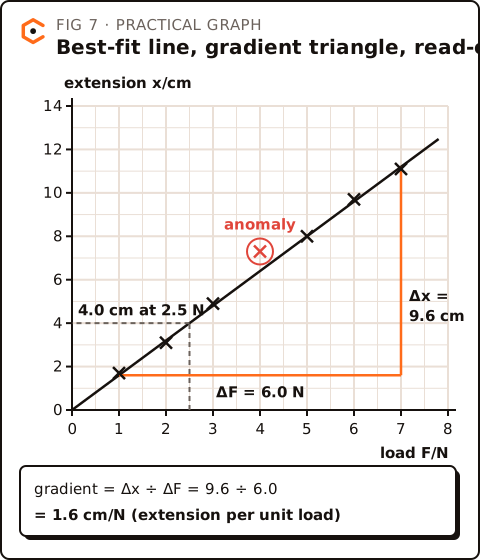
Here the gradient is 9.6 cm ÷ 6.0 N = 1.6 cm/N, the extension per unit load. Reading from the line at 2.5 N gives 4.0 cm.
Evaluating and improving: be specific
The June 2024 examiner reports say practical answers must be based on practical considerations, not theory, and should fit the experiment in the question. Some candidates repeated answers learned from old mark schemes that did not fit the new question.
| Weak | Stronger (for the spring experiment) |
|---|---|
| Human error. | The rule was not vertical next to the spring, so readings may be too high or too low. Clamp a second rule vertically beside the spring. |
| Be more careful. | The spring was still moving when the reading was taken. Wait until it is still before reading. |
| Repeat the experiment. | Repeat each reading while unloading as well as loading and take the average, to reduce the effect of random errors. |
| Use better equipment. | Use a pointer fixed to the bottom of the spring and read it with your eye level with the pointer, to avoid parallax. |
Revision plans
An 8-week plan
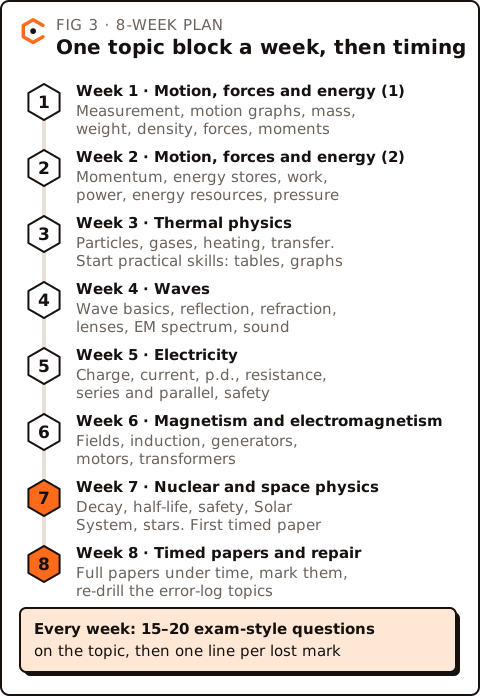
Each topic week has the same shape: work through the checklist, learn the equations for that topic, then answer 15 to 20 exam-style questions and mark them. Every lost mark goes in an error log: one line with the question, what you wrote, what was needed, and the rule you will follow next time. Read the log every weekend. The slips that keep appearing are the cheapest marks to win back.
A 4-week plan
If the exam is closer, compress the topics but keep the final week for timed papers.
| Week | Topics | Practice |
|---|---|---|
| 1 | Motion, forces and energy | Daily calculation drill with the five-step layout; one set of graph questions |
| 2 | Thermal physics and waves | Ray diagrams with a ruler and protractor; one practical write-up (table and graph) |
| 3 | Electricity and magnetism, nuclear, space | Circuit calculations; half-life readings; a first timed multiple-choice paper |
| 4 | Timed papers | One theory, one multiple-choice and one practical paper under time, marked, then error-log repair |
Common mistakes by topic
The points marked examiner report are from Cambridge's June 2024 Principal Examiner Report for 0625, in our own words. The others are general advice from ConceptCIE, not from Cambridge.
Motion, forces and energy
- Reading a speed–time graph as if it were a distance–time graph, and forgetting the ½ when finding the area of a triangle. (examiner report)
- Treating speed and velocity as the same thing. (examiner report)
- Dividing volume by mass instead of mass by volume for density. (examiner report)
- Defining acceleration as "rate of change of velocity per unit time", which says "per unit time" twice. Use one or the other. (examiner report)
- Forgetting that momentum has direction, so two objects moving in opposite directions have momenta of opposite signs. (examiner report)
- Using a distance that is not perpendicular to the force when calculating a moment. (general advice)
Thermal physics
- Assuming gas pressure rises on heating even when a piston is free to move. (examiner report)
- Treating pressure and volume as directly proportional, or knowing they move in opposite directions but missing that they are inversely proportional. (examiner report)
- Mixing up temperature and internal energy, or using T for time. (general advice, and the report asks for syllabus symbols)
Waves
- Not converting kHz to Hz, or cm to m, before using v = fλ. (examiner report)
- Drawing a refracted ray when the angle of incidence is bigger than the critical angle. (examiner report)
- Saying "the wavelength refracts" instead of saying the wavelength decreases because the light slows down. (examiner report)
- Measuring angles from the surface instead of from the normal. (general advice)
Electricity and magnetism
- Getting the factor of 2 the wrong way round for two equal resistors in parallel. The combined resistance is half of each resistor, so each resistor is double the combined value. (examiner report)
- Assuming the p.d. across parts of a potential divider stays the same when a resistance changes. (examiner report)
- Writing "lamps get the same voltage" as the advantage of parallel lighting, which is true but not the point: say each lamp gets the full supply p.d., and if one lamp fails the others stay on. (examiner report)
Nuclear and space physics
- Counting three half-lives correctly and then dividing the half-life by three instead of multiplying. (examiner report)
- Mixing up the order of the electromagnetic spectrum, for example thinking X-rays have the longest wavelength. (examiner report)
- Leaving off the unit when recalling a value such as the Hubble constant. (examiner report)
Practical papers
- Small gradient triangles, awkward scales, and points that do not use half the grid. (examiner report)
- Forcing the best-fit line through the origin, and not marking anomalies that were ignored. (examiner report)
- Rounding raw readings to make plotting easier, or overwriting a reading instead of crossing it out. (examiner report)
How to use past papers well
Cambridge's 0625 past papers page has a public selection. When we checked, it had the June 2024 papers with mark schemes, the 2023 specimen papers and the June 2024 examiner report. Your teacher can get many more series from Cambridge's School Support Hub.
- Prefer recent papers. Cambridge says textbooks endorsed for exams from 2023 still suit the current syllabus, so papers from 2023 onwards are the closest match. Older papers are still useful for topic practice, but check each question against the current syllabus, because the content has changed over the years.
- Do topic sets first, full papers later. Mix questions from one topic across several papers in the topic weeks. Save complete, timed papers for the end.
- Time yourself honestly. Use the real time limits and no notes.
- Mark with the mark scheme, then read the examiner report. The mark scheme shows what earned each mark. The report explains why candidates lost marks, which is often more useful.
- Log every lost mark. Write the rule you will use next time, not just the correct answer.
- Learn the reasoning, not the wording. The 2024 report warns about candidates who repeated mark-scheme answers that did not fit a new question.
- Keep one or two unseen papers for your final week, so you get a fair test.
Glossary
- Accuracy: how close a measurement is to the true value.
- Precision: how close repeated measurements are to each other.
- Anomaly: a result well outside the pattern of the others.
- Independent variable: the quantity you change on purpose.
- Dependent variable: the quantity you measure as a result.
- Control variable: a quantity you keep the same so the test is fair.
- Zero error: an instrument that reads something other than zero when it should read zero.
- Best-fit line: a single thin line or smooth curve that follows the trend, with points spread evenly either side.
- Resultant force: the single force with the same effect as all the forces acting together.
- Terminal velocity: the steady velocity reached when the resistive force balances the weight.
- Specific heat capacity: the energy needed to raise the temperature of 1 kg of a substance by 1 °C.
- Critical angle: the angle of incidence in the denser medium at which the refracted ray just travels along the boundary.
- e.m.f.: the energy a source gives each unit of charge it drives around a complete circuit, measured in volts.
- Potential difference: the energy transferred per unit charge passing through a component, also in volts.
- Half-life: the time for half the nuclei of a radioactive isotope in a sample to decay.
- Background radiation: ionising radiation that is always around us, from sources such as radon, rocks and cosmic rays.
Keep going
Physics marks come from practice with feedback. If you want help with a topic, ConceptCIE has a Physics tutor, Mr Volt. Chat with our tutors is being updated, so check his page for what is available now.
For more revision help, read the difference between IGCSE and GCSE or our Cambridge A Level Maths 9709 revision guide if you are thinking ahead.
Quick answers
What is the difference between Core and Extended in IGCSE Physics 0625?
Core candidates sit Paper 1 (multiple choice) and Paper 3 (theory) and can get grades C to G. Extended candidates sit Paper 2 and Paper 4, which also test the Supplement content, and can get grades A* to G. Both routes take the same practical choice: Paper 5 or Paper 6. Your school makes the entry, so check with your teacher which route you are on.
Should I take Paper 5 or Paper 6?
Your school enters you for one of them. Paper 5 is a Practical Test done in a laboratory (1 hour 15 minutes) and Paper 6 is the written Alternative to Practical (1 hour). Both are worth 40 marks and 20% of the qualification, and Cambridge says they need the same experimental skills and test the same assessment objective.
Is there a formula sheet in IGCSE Physics 0625?
Plan as if there is not. The syllabus says 'recall and use' for each equation, so you need to learn them. Cambridge's specimen Paper 4 (for examination from 2023) gives the value to use for g (9.8 m/s²) on its front cover, but no list of equations. Check the front cover of each past paper you practise with.
Can I use a calculator in IGCSE Physics?
Yes. The 0625 syllabus says calculators may be used in all parts of the examination. Answers should be written as decimals (or percentages where that fits), not fractions.
Has the 0625 syllabus changed for 2026 to 2028?
Cambridge says there are no significant changes which affect teaching. The 2026-2028 syllabus is version 2, published December 2025, and the paper structure is the same as before. A separate syllabus for exams in 2029 has also been published, and Cambridge says that one has no significant changes either.
How long should I spend revising IGCSE Physics?
This depends on your starting point and how many other subjects you take. As a template, eight weeks lets you cover each topic block once and still leave time for timed papers; a four-week version is below for when the exam is closer. Cambridge's figure of about 130 guided learning hours is teaching time for the whole course, not revision time.
Where can I find official IGCSE Physics past papers?
Cambridge's 0625 past papers page has a public selection, which at the time of checking included the June 2024 papers and mark schemes, the 2023 specimen papers and the June 2024 examiner report. Teachers at registered Cambridge schools can get many more through the School Support Hub, so ask your teacher.
Which IGCSE Physics topic is the biggest?
Motion, forces and energy has 8 of the 24 sections in the syllabus, more than any other topic, and many calculation skills start there. Cambridge does not publish a marks split by topic, so do not assume each topic carries the same number of marks.
Sources
- Cambridge IGCSE Physics 0625 syllabus for 2026, 2027 and 2028 (version 2)www.cambridgeinternational.org
- Cambridge IGCSE Physics 0625 syllabus for 2029www.cambridgeinternational.org
- Cambridge IGCSE Physics 0625: past papers pagewww.cambridgeinternational.org
- Cambridge IGCSE Physics 0625: Principal Examiner Report for Teachers, June 2024www.cambridgeinternational.org
- Cambridge IGCSE Physics 0625: specimen Paper 4, for examination from 2023www.cambridgeinternational.org
Revise with ConceptCIE
Subject tutors, notes and harder-than-exam practice for Cambridge International students. Parts are still being updated; a free account gets each one as it opens.
No card · 10 free tutor prompts when tutor chat opens
Related posts
A Level Maths revision guide (Cambridge 9709)
27 min read
A Level Maths revision for Cambridge 9709: valid paper routes, topic checklists, how M, A and B marks work, 11 worked examples and 12-week and 6-week plans.
IGCSE vs GCSE: what's the difference?
16 min read
The difference between GCSE and IGCSE explained: who sets each exam, 9–1 and A*–G grades, tiers, exam series, recognition, and how to check which one you sit.