IGCSE
IGCSE vs GCSE: what's the difference?
The difference between GCSE and IGCSE explained: who sets each exam, 9–1 and A*–G grades, tiers, exam series, recognition, and how to check which one you sit.
By ConceptCIE Team16 min read
Last updated
GCSE and IGCSE are taken at the same age, cover similar subjects and lead to the same next steps, so it is easy to treat them as one thing. They are not. This guide explains the difference between GCSE and IGCSE in practical terms: who sets each exam, how the grades work, what tiers do to your top grade, when you can sit the papers, how universities and sixth forms treat them, and how to check exactly which qualification you are on. It is written for students and parents in international schools, in UK independent schools and anywhere a transcript mixes the two.
The short answer
- A GCSE is the qualification most students in England, Wales and Northern Ireland take at 14 to 16. In England it is graded 9 to 1.
- An IGCSE is Cambridge's international qualification for the same age group. Most Cambridge IGCSEs are graded A* to G. Pearson Edexcel and OxfordAQA run their own International GCSEs, graded 9 to 1.
- Many subjects are tiered. Your tier can cap your best possible grade at C or 5.
- They are recognised as the same stage of education, and both lead to A Levels and other post-16 courses. Individual universities and schools set their own entry rules.
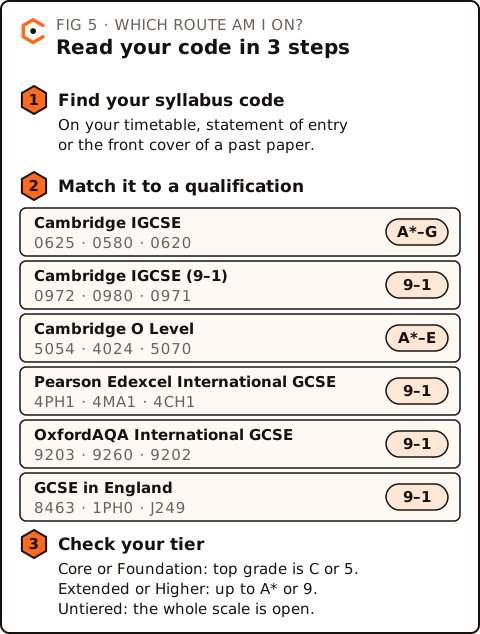
- You usually do not choose. Your school picks the board and syllabus. The syllabus code tells you which one you are on.
What GCSE and IGCSE actually are
GCSE: the UK qualification
GCSEs are taken at the end of key stage 4 (age 14 to 16) in England, and also in Wales and Northern Ireland. Each nation runs its own system:
- England: GCSEs are regulated by Ofqual and set by four exam boards: AQA, OCR, Pearson Edexcel and WJEC Eduqas. They have been graded 9 to 1 since 2017.
- Wales: GCSEs set by WJEC are graded with letters, A* to G.
- Northern Ireland: CCEA uses a letter scale, A* to G. CCEA says it added a C* grade from 2019 to sit alongside grade 5 on the English scale, and students there can also take 9 to 1 GCSEs from the English boards.
- Scotland does not use GCSEs. It has its own qualifications, such as National 5.
IGCSE and International GCSE: the international versions
Cambridge created the IGCSE and describes it as a qualification for 14 to 16 year olds with over 70 subjects to choose from. Cambridge designs each subject to need about 130 guided learning hours of teaching. Assessment happens at the end of the course and, depending on the subject, includes written, oral, coursework and practical assessment.
One naming detail matters: IGCSE is a Cambridge trademark. The Department for Education points this out in its own reports. Pearson Edexcel and OxfordAQA (a partnership between Oxford University Press and AQA) offer International GCSEs, and people often call these "IGCSEs" too. On a transcript, the board name tells you which one it is.
Where Cambridge O Level fits
Cambridge O Level is a separate Cambridge qualification for the same stage, common in some countries. It is graded A* to E, its syllabuses have their own codes, and Cambridge describes it as equivalent to the IGCSE. Cambridge offers O Levels only in some of its administrative zones (the regions it groups schools into for timetables).
Cambridge has also announced a phased move from selected O Level syllabuses to IGCSE in administrative zones 3 and 5. Five subjects (including Accounting, Economics and Additional Mathematics) are planned to be assessed only as IGCSEs from June 2028, and three more, including Mathematics (Syllabus D), from 2029. Cambridge says O Levels will continue in zone 4. Cambridge says the first phase keeps the same content and assessments, with a new name and syllabus code. You can look up your school's zone on the Cambridge website, or ask your exams officer.
Who sets the exams
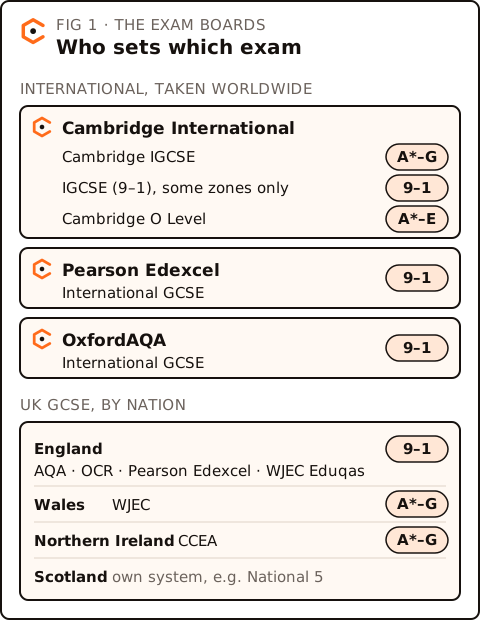
| Board | What it offers at this stage | Grade scale |
|---|---|---|
| Cambridge International | Cambridge IGCSE; Cambridge IGCSE (9–1) in some zones; Cambridge O Level | A*–G; 9–1; A*–E |
| Pearson Edexcel | International GCSE (and GCSE in England) | 9–1 |
| OxfordAQA | International GCSE | 9–1 |
| AQA, OCR, WJEC Eduqas | GCSE in England | 9–1 |
| WJEC | GCSE in Wales | A*–G |
| CCEA | GCSE in Northern Ireland | Letters, A*–G |
OCR now brands itself as Cambridge OCR on its website. It is still a UK GCSE board, separate from Cambridge International, which runs the IGCSE.
The difference between GCSE and IGCSE grading
Grading is where most of the confusion comes from, because there are two scales in use and they do not convert one to one.
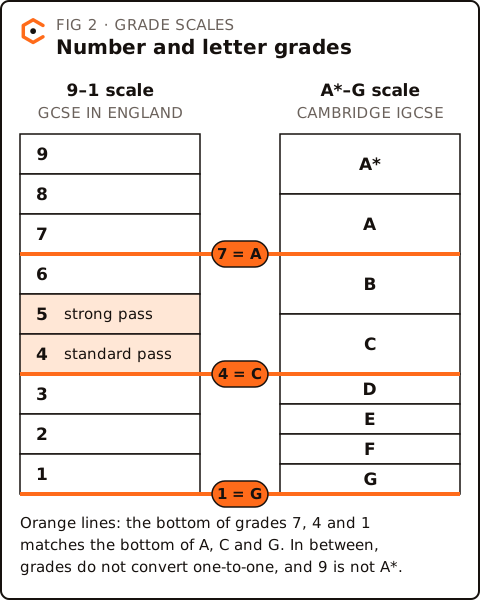
The 9 to 1 scale (GCSEs in England)
9 is the top grade and 1 the lowest; U means ungraded. Ofqual fixes the new scale to the old one at three points:
- the bottom of grade 7 matches the bottom of the old A
- the bottom of grade 4 matches the bottom of the old C
- the bottom of grade 1 matches the bottom of the old G
Between those points there is no exact conversion. Ofqual says plainly that the number scale is not directly equivalent to the letter one.
What 4 and 5 mean
The Department for Education calls grade 4 a standard pass and grade 5 a strong pass. Grade 4 is the one most rules hang on. For example, in England, students aged 16 to 18 who have not got a grade 4 in maths or English are normally required to keep studying those subjects as part of their post-16 course. Sixth forms and colleges set their own entry grades, and many ask for more than a 4 in the subjects you want to take further, so check the ones you are applying to.
The A* to G scale (most Cambridge IGCSEs)
Cambridge IGCSE grades run A*, A, B, C, D, E, F, G, with "ungraded" below G. Ungraded appears on the statement of results but not on the certificate. Cambridge's Physics 0625 syllabus, for example, says students with A* to C are well prepared for a wide range of courses, including Cambridge AS and A Level Physics.
Cambridge IGCSE (9–1)
Cambridge also offers some IGCSEs on the 9 to 1 scale, with their own codes: for example Physics (9–1) is 0972, while Physics A*–G is 0625. Cambridge says the content and assessment are the same; only the code and the grade set differ. On its 9–1 grading:
- the thresholds of 7, 4 and 1 match the thresholds of A, C and G
- grades 8, 6, 5, 3 and 2 are spaced evenly between those points
- grade 9 is set using a mix of statistics and examiner judgement
These 9–1 syllabuses are offered only in some administrative zones (Cambridge's 0972 page names zone 3, plus schools in Oman and the UAE). All schools can keep A* to G. Once the entries deadline passes, a student cannot switch to the other scale.
Pearson Edexcel and OxfordAQA International GCSEs
Both use 9 to 1. Pearson says its International GCSEs are comparable to UK GCSEs. They are not regulated by Ofqual: in 2019 Ofqual said it expected to regulate no international GCSEs from April 2020.
Reading a mixed transcript
Tiers: Core, Extended, Foundation and Higher
Many subjects are tiered: you sit easier or harder papers, and your tier limits the grades you can get. Cambridge calls its tiers Core and Extended. GCSE boards and Pearson Edexcel call theirs Foundation and Higher.
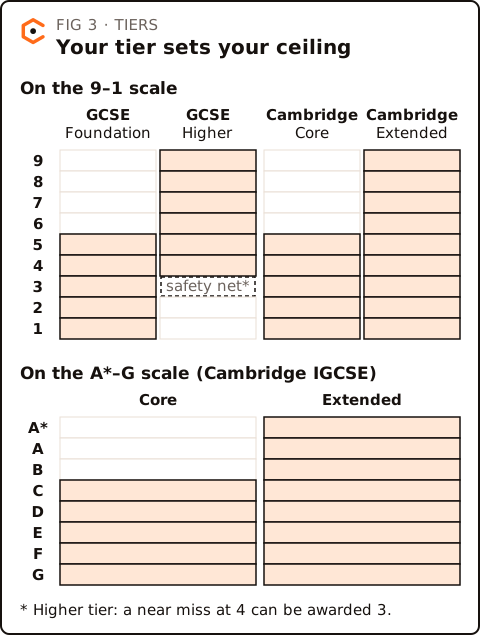
| Qualification (example) | Lower tier | Upper tier |
|---|---|---|
| GCSE in England (tiered subjects such as maths and the sciences) | Foundation: 5 to 1 | Higher: 9 to 4, with a narrow grade 3 for a near miss |
| Cambridge IGCSE, e.g. Physics 0625 | Core: C to G | Extended: A* to G |
| Cambridge IGCSE (9–1), e.g. Physics 0972 | Core: 5 to 1 | Extended: 9 to 1 |
| Pearson Edexcel International GCSE Maths A (4MA1) | Foundation: 5 to 1 | Higher: 9 to 4, grade 3 allowed |
| Pearson Edexcel International GCSE Physics (4PH1), Chemistry, Biology | Untiered: one set of papers for everyone | |
| Cambridge O Level, e.g. Physics 5054 | Untiered: every candidate can get A* to E |
Two patterns to notice:
- Cambridge Extended goes all the way down (to G or 1), so a bad day does not leave you ungraded as easily. GCSE Higher stops at 4, with only a narrow safety-net 3 below it.
- Core and Foundation stop at C or 5. That is a pass, but it closes off the top grades no matter how well you do.
OxfordAQA also tiers its International GCSE Maths (9260), calling the tiers Core and Extension. Check its current specification for the exact grade range.
Coursework and practical work
Most marks in both qualifications come from written exams at the end of the course, but the details differ by subject and board.
- Cambridge IGCSE: some subjects include coursework, orals or a practical. In the sciences there is often a choice your school makes: in Physics 0625, for example, students sit either Paper 5 (a practical test in the lab) or Paper 6 (a written Alternative to Practical), both testing the same skills.
- GCSE sciences in England: assessed by written exams only. You must do a set of required practicals (at least 8 in each single science, 16 in combined science) and keep a record of them, and exam questions then test what you learned from them.
- Pearson International GCSE sciences: untiered written papers.
Coursework rules change between syllabus versions, so read the "assessment overview" page of your current syllabus.
Exam series and dates
| Qualification | When you can sit it |
|---|---|
| Cambridge IGCSE and O Level | June and November; March for some IGCSE syllabuses in India only |
| Pearson Edexcel International GCSE | May/June and November (the January series ended after January 2023) |
| OxfordAQA International GCSE | November and May/June (2026/27 dates) |
| GCSE in England | May/June (2026 exams ran 7 May to 23 June); November only for English language and maths, for students aged 16 or over on 31 August |
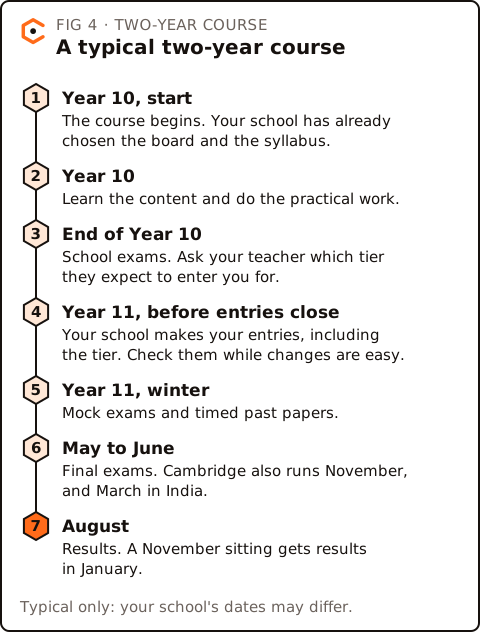
Cambridge publishes a separate timetable for each administrative zone, so a paper can fall on different dates in different countries. Results from the June series arrive in August, and results from November in January. For example, Cambridge released its June 2026 IGCSE and O Level results in mid-August 2026, and Ofqual lists GCSE results day for summer 2027 as Thursday 19 August 2027.
How recognised they are
Here is what the primary sources say, without the marketing.
- In England, the Department for Education's 2026 to 2027 funding guidance lists "international GCSEs, regulated or unregulated" at grades 9 to 4, and international O Levels at A* to C, as prior attainment that counts like a GCSE. It also says international GCSEs continue to count as equivalent to GCSEs for recognising prior attainment.
- UK ENIC (formerly UK NARIC), the UK's agency for comparing international qualifications, benchmarked the Cambridge IGCSE and found it comparable to the standard of the UK GCSE, according to Cambridge.
- Pearson describes its International GCSE as comparable to the UK GCSE and accepted by universities around the world.
- School league tables: international GCSEs have not counted in England's school performance tables since the reformed GCSEs arrived from 2017. As a result, in 2018, 94% of international GCSE entries in England came from independent schools.
Recognition is decided by each institution, not by the exam board. Before you rely on a result, check:
- the exact grades and subjects the course page asks for
- whether it lists IGCSE, International GCSE or O Level by name, or asks for "GCSE or equivalent"
- how it converts letter grades if it asks for numbers (or the reverse)
- any extra English language requirement
- local rules if you are applying in your home country, which may have their own equivalence process
Is IGCSE harder than GCSE?
The honest answer is "it depends on the subject and the board", and there is government evidence for that.
In 2019 the Department for Education published an analysis of 2018 results for independent school pupils in England who took GCSEs and international GCSEs. It found:
- Cambridge IGCSEs: grades were similar to GCSEs overall, with an average difference of less than a tenth of a grade. By subject, pupils did better than expected in English language and literature, and worse than expected in the sciences, French and geography. There was no clear difference in maths, German, Spanish and history.
- Pearson International GCSEs: pupils got higher grades than in their GCSEs by around a quarter of a grade on average, especially in English and maths. The evidence for biology, physics and geography was mixed.
The minister's letter to MPs stressed that the analysis covered one year only, and that the boards had already made changes that might give a different picture in 2019. Ofqual has said it is not possible to say with any precision how the standards of the two qualifications compare.
What this means for you: the label on the certificate matters less than your specific subject, board and tier. Prepare for your own papers, not for a reputation.
Which should you choose?
Most students do not choose. Your school picks the board and syllabus for each subject, often based on where it is and how it is set up. Where you do have a say, these are the questions worth asking your school:
- Which board and syllabus code will I sit for each subject?
- Is it graded A*–G, 9–1 or A*–E?
- Which tier do you expect to enter me for, and when is that decided?
- Which series will I sit (June or November), and is there a resit option?
- Is there coursework, an oral or a practical, and which practical paper does the school use?
- What grades does the sixth form or post-16 college ask for in the subjects I want to continue?
- If I move country or school, can I keep the same syllabus?
If you are planning to study in a particular country, check that country's university or equivalence rules early, especially if your results will mix letter and number grades.
If your school offers both
Some schools offer a GCSE in one subject and an IGCSE or International GCSE in another, or let families pick. If that is you:
- Compare the two syllabuses' topic lists, not just the names. Content differs between boards.
- Compare how each is tiered. An untiered paper or a Cambridge Extended entry leaves more grades open below your target.
- Check whether one has coursework or a practical exam and which suits you.
- Look at a recent past paper from each and see which question style you handle better.
- Ask your teacher which one they have taught most often. Experience with a syllabus matters.
- Check whether your next school or course mentions either by name.
Common myths
- "IGCSEs aren't accepted in the UK." The Department for Education treats international GCSEs at 9 to 4 like GCSEs for prior attainment, and Cambridge and Pearson both say universities accept their versions. Individual courses still set their own requirements.
- "Grade 9 is just A*." No. Only 7/A, 4/C and 1/G are fixed points.
- "Core or Foundation means you've failed." These tiers top out at C or 5, which are pass grades. The problem is only if you need higher.
- "All IGCSEs use letters." Pearson Edexcel and OxfordAQA use 9 to 1, and Cambridge offers 9–1 versions in some zones.
- "O Level is a lower qualification than IGCSE." Cambridge describes them as equivalent and of equal rigour.
- "You can sit any GCSE in November." In England, November is only for English language and maths, for students aged 16 or over.
What changes for revision
The biggest practical difference is that your past papers must come from your own board and syllabus code. A Cambridge IGCSE Physics paper and an AQA GCSE Physics paper cover overlapping topics but differ in question style, paper length, command words and mark schemes. Use the other board's papers only for extra topic practice, after you have worked through your own.
Syllabus codes for four subjects
International qualifications:
| Subject | Cambridge IGCSE (A*–G) | Cambridge IGCSE (9–1) | Cambridge O Level | Pearson Edexcel Int. GCSE | OxfordAQA Int. GCSE |
|---|---|---|---|---|---|
| Mathematics | 0580 | 0980 | 4024 (Syllabus D) | 4MA1 | 9260 |
| Physics | 0625 | 0972 | 5054 | 4PH1 | 9203 |
| Chemistry | 0620 | 0971 | 5070 | 4CH1 | 9202 |
| Biology | 0610 | 0970 | 5090 | 4BI1 | 9201 |
GCSEs in England:
| Subject | AQA | Pearson Edexcel | OCR |
|---|---|---|---|
| Mathematics | 8300 | 1MA1 | J560 |
| Physics | 8463 | 1PH0 | J249 (Gateway Physics A) |
| Chemistry | 8462 | 1CH0 | J248 (Gateway Chemistry A) |
| Biology | 8461 | 1BI0 | J247 (Gateway Biology A) |
Codes last checked on 16 October 2026. OxfordAQA's site also lists a revised maths specification (9233), and boards replace codes when they redesign a syllabus, so check the code on your own entry.
A revision routine that works for either
- Download the current syllabus for your code from your board's website and turn its topic list into a checklist.
- Mark each topic red, amber or green after an honest self-test.
- Do past papers from your own board under timed conditions, then mark them with the official mark scheme.
- Keep an error log: the topic, what went wrong, and the fix.
- If you are on a lower tier, make sure you practise the questions your tier's papers actually contain, not the hardest ones from the upper tier.
Glossary
- Awarding body (exam board): the organisation that sets, marks and certificates the exam, such as Cambridge International, Pearson Edexcel, OxfordAQA, AQA or OCR.
- Syllabus / specification: the official document listing what you must learn and how you are assessed. Cambridge says "syllabus"; UK boards usually say "specification".
- Syllabus code: the number or code that identifies your exact qualification, such as 0625 or 8463.
- Component (paper): one part of the assessment, such as Paper 2 or a practical.
- Tier: the level of papers you sit: Core or Extended, Foundation or Higher.
- Grade threshold (grade boundary): the minimum mark for each grade in a particular series. It moves a little from series to series.
- Series: an exam season, such as June or November.
- Administrative zone: one of the regions Cambridge groups schools into, each with its own timetable.
- Entry: your school's registration of you for a syllabus, tier and series.
- Safety-net grade: the narrow grade 3 a GCSE Higher tier student can get after just missing a 4.
Keep going
If you are taking Cambridge exams, our Cambridge IGCSE Physics 0625 revision guide shows how one IGCSE is built paper by paper, and the A Level Maths revision guide for Cambridge 9709 covers the step after IGCSE. ConceptCIE is a study site for Cambridge IGCSE, O Level, AS and A Level, and you can create a free account to get started.
Quick answers
What does IGCSE stand for?
International General Certificate of Secondary Education. That is how Cambridge prints it on statements of results and certificates. IGCSE is Cambridge's trademarked name; Pearson Edexcel and OxfordAQA call their versions International GCSEs.
Is an IGCSE equivalent to a GCSE?
They are different qualifications at the same stage, usually taken at 14 to 16. In England, the Department for Education counts international GCSEs at grades 9 to 4 as prior attainment equivalent to GCSEs, and Cambridge and Pearson both say their versions are comparable to the UK GCSE. Ofqual, England's regulator, says it is not possible to say precisely how the standards compare. Universities and sixth forms set their own rules, so check the course you want.
Is IGCSE harder than GCSE?
Not across the board. A Department for Education analysis of 2018 results for independent school pupils in England found no systematic difference between Cambridge IGCSEs and GCSEs overall, but grades were higher than expected in Cambridge IGCSE English and lower in the sciences. Pearson International GCSEs were graded about a quarter of a grade more generously on average that year. It covered one year only, so treat it as a snapshot.
Is a grade 9 the same as an A*?
No. The two scales only line up at three points: the bottom of 7 matches the bottom of A, the bottom of 4 matches the bottom of C, and the bottom of 1 matches the bottom of G. Ofqual says the number scale is not directly equivalent to the letter one, and Cambridge sets its grade 9 using both statistics and examiner judgement.
What counts as a pass at GCSE?
In England, the Department for Education calls grade 4 a standard pass and grade 5 a strong pass. Grade 4 is the grade most post-16 rules use: for example, students in England without a grade 4 in English or maths usually keep studying them after 16. Schools and colleges can set higher entry grades for particular courses.
Is O Level the same as IGCSE?
No, but they sit at the same stage. Cambridge O Level is a separate Cambridge qualification with its own syllabuses, graded A* to E. Cambridge describes O Level as equivalent to IGCSE, and plans to move some O Level subjects to IGCSE in some regions from 2028.
Can I go on to A Levels after IGCSEs?
Yes. IGCSEs and International GCSEs are a normal route into AS and A Levels, the IB Diploma and other post-16 courses, in the UK and elsewhere. Each school or college sets its own entry grades, so check the subjects and grades your chosen course asks for.
Can I resit in November?
Cambridge IGCSE and O Level run June and November series, and Pearson Edexcel and OxfordAQA International GCSEs also have a November series. GCSEs in England only offer November for English language and maths, and only to students aged 16 or over on 31 August of that year.
Sources
- Ofqual: GCSE 9 to 1 grade scale explainedwww.gov.uk
- Ofqual: what you need to know before your exams (student guide 2026)www.gov.uk
- Ofqual blog: some facts about international GCSEs (2019)ofqual.blog.gov.uk
- Department for Education: comparing international GCSEs and GCSEs in England, 2018www.gov.uk
- Department for Education: 16 to 19 funding, maths and English condition of funding, 2026 to 2027www.gov.uk
- GOV.UK Ethnicity facts and figures: GCSE English and maths results (standard and strong pass)www.ethnicity-facts-figures.service.gov.uk
- Ofqual: a new approach to GCSE science practical assessment (2015)www.gov.uk
- Cambridge International: Cambridge IGCSEwww.cambridgeinternational.org
- Cambridge International: grading choice and how 9-1 grading workswww.cambridgeinternational.org
- Cambridge IGCSE Physics 0625 syllabus for 2026, 2027 and 2028www.cambridgeinternational.org
- Cambridge IGCSE (9-1) Physics 0972 syllabus pagecambridgeinternational.org
- Cambridge O Level Physics 5054 syllabus for 2026, 2027 and 2028www.cambridgeinternational.org
- Cambridge International: transition from Cambridge O Level to Cambridge IGCSEinternational.cambridge.org
- Cambridge International: recognition in the UKcambridgeinternational.org
- Pearson: about Edexcel International GCSEsqualifications.pearson.com
- Pearson: International GCSE November series from 2023qualifications.pearson.com
- Pearson Edexcel International GCSE Mathematics A (4MA1) specificationqualifications.pearson.com
- Pearson Edexcel International GCSE Physics (4PH1) specification, issue 4qualifications.pearson.com
- OxfordAQA: International GCSE qualificationswww.oxfordaqa.com
- OxfordAQA: dates and timetableswww.oxfordaqa.com
Revise with ConceptCIE
Subject tutors, notes and harder-than-exam practice for Cambridge International students. Parts are still being updated; a free account gets each one as it opens.
No card · 10 free tutor prompts when tutor chat opens
Related posts
Cambridge IGCSE Physics (0625): revision guide
24 min read
Cambridge IGCSE Physics 0625 revision: how the papers work, topic checklists, key equations, worked examples, practical skills, and 8-week and 4-week plans.